www.derby-signalling.org.uk
Some Derby Area Railway Accidents
The travelling public have much to thank the Board of Trade for. Their meticulous inspection of every detail of Railway Operation is a significant factor in making railways the safest form of travel. When things do go wrong the Railway Inspectorate of the Board of Trade (or, these days, the Health & Safety Executive) cast a detailed, and often critical, eye over the events, operation and equipment which were involved in the mishap.
To a signalling enthusiast, these Board of Trade reports also provide a tantalising glimpse into signal boxes of the past. Here are the stories behind a number of mishaps in the Derby area which serve to illustrate how small mistakes so easily combine with fate. One can read a multitude of documents and learn how the railway should be worked, it is only when it all goes horribly wrong that we learn from these documents how the job was done on a day-to-day basis.
Accident at Derby Station, 30th November 1880.
James Smith had a bad day on Tuesday 30th November 1880. He booked on for early turn as signalman at Derby Station North signal box at 6a.m. He had been a regular man there since 20th July that year, and as a signalman for 12 years he had worked his way up to the responsible post that this Special Class box undoubtedly was.
The signal fitters were busy in and around his signal box, having installed a new signal 21 the previous day, and Tuesday had been set aside to "put on the proper lock for this signal". History doesn't record what function this new signal was to perform, this being before the resignalling associated with the widening over the River Derwent in 1891, no diagram of this time has surfaced. In any event, it wasn't signal 21 that was to catch the unfortunate Signalman Smith out.
The leading hand of the gang of locking fitters carrying out the work was Thomas Daken. The work to fit the new lock was obviously quite complex because it wasn't until about 11am that he made a start. He stated to Major Francis Marindin, during the subsequent enquiry, that “I had to take out five of the [locking] bars, thus destroying the interlocking”. Daken doesn't seem to have done Smith any favours; “I told the signalman I had to take out some locks, but I didn't tell him which. I told him to be careful to work just as if the locking was there”.
Modern day railwaymen will be shuddering already...
Smith's account differs slightly in that he had no recollection Daken or his gang mentioning the locking at all, but he did see them take at least one locking bar out and readily acknowledged he knew the interlocking on his frame wasn't complete – he just didn't know in what respect nor did he see fit to ask.
His eight hour shift was almost over when the Leeds to London express was signalled into Platform 4, running about four minutes late at 1.48pm. Waiting patiently for the Leeds train to pass was Driver George Radford with Fireman John Grayson on the footplate of No. 1051 running as Engine & Brake for Belper. Their route took them from the yard at Engine Sidings box onto the Down main line. They were held at signal No.15, protecting the safety points worked by lever No. 16.
Looking in the opposite direction, running into the station on the Up line from the North, there are four possible routes. A four armed signal directed accordingly;
Top arm, worked by lever No.4, routed through some facing points which were worked and locked by lever No.8, onto the Goods line. Points No.8 lay Normal toward the Goods line.
Second arm, lever No. 5, routed into Platform 4.
Third arm, lever No. 6, to Platform 3.
Bottom arm, lever No. 7 to No. 2 Platform.
Signalman Smith told Maj. Marindin that he let the Engine and Brake out behind the Leeds train, and in order to do so he put back points No.8, pulled lever No.16 to reverse the safety points, and then lever No. 15 to clear the signal. As he was doing so, Derby Junction asked the road for the 12.10pm express from Manchester to London with Thomas Stafford at the regulator. The last stop for this service had been Millers Dale, but they had been checked by signals at Ambergate for a northbound express. Even so, as this train approached Derby it was running to time and crossed the canal bridge north of the station at a sedentary 10 to 12 miles per hour.
Meanwhile, the Engine and Brake having cleared the main line and set off on its way to Belper, Smith accepted the Manchester train and “sent the signal to the station and got back a signal to send the train into No.3 line”. Smith then pulled lever No.8 to reverse the facing points from the Goods line, as well as facing points No.31 to set the road into Platform 3. He followed this by pulling off signals Nos. 2, 6, and the Distant No.1.
On the footplate of 4-4-0 No. 1315, Driver Stafford saw the signals come off and gently ran into the station. His description of the engine coming off the road on the facing points between Platform 3 and 4 is very undramatic; “I felt the engine jump at the front end and after running three or four yards the bogie left the road. As soon as I felt the jump I applied the break [sic], and it acted very well, bringing the train to as stand in about 50 yards”.
In the investigation that followed the most pertinent evidence came from George Marshall, leading hand of a gang of facing point fitters. He gave evidence that shortly after the accident he examined points No.8 and although they were lying for the passenger line, the lefthand switch was about half an inch open. Most tellingly, when he opened the undamaged casing of the facing point lock he found “the two right-hand lugs on the locking plate were broken off, the fractures being quite fresh”. His conclusion based on this damage was that it had all the signs of an engine running through the points and forcing them open.
Maj. Marindin was certainly left in no doubt. He charitably credited Smith that “his memory may be at fault” rather than damning him with lying. Nevertheless the Major concluded there could be no doubt that Smith had fallen into the trap laid for him by the locking fitters. He had pulled off signal 15 to let the Engine and Brake out without first putting back lever No.8 to set the trailing points for that movement.
On the copy of the accident report in the Midland Railway Study Centre, the final paragraph of Major Marindin's conclusions have been highlighted with a pencil mark alongside – and with good cause;
I consider that in as such cases, where it may be necessary to carry out work interfering with the interlocking in any signal cabin, the signalman should receive from some authorised person an exact statement of the points and signals which he will temporarily be called upon to work without the usual safeguard of interlocking, and a man should be stationed close to them to see than no mistake occurs.
It would seem that the Midland Railway management took that one on the chin as Signalman Smith kept his job, appearing on records as a signalman as late as 1903.
That wasn't the end of the bad day, however...
Thomas Harbidge came on to work the night shift in Derby Station North signal box at 10pm the same day as the earlier derailment. He received an instruction from the man who had releived Signalman Smith to the effect that the interlocking on points No.31(the facing points between Platforms 3 and 4) had been broken. The instruction was that all trains were to be “pulled up to a slow speed”.
All was well until 2am the following morning when Driver Charles Simmonds approached Derby with No. 108, an 0-6-0 at the head of 14 vehicles forming the 11.30pm up express from Leeds. Despite being checked at Derby North Junction, Derby Junction and Derby Station North, resulting in him approaching the station at 6mph, his engine still managed to drop off the road at No.31 points. The Leeds train was already running 32 minutes late, though this doesn't appear to have had a bearing on things. Signalman Harbidge gave evidence that he kept his home signal at danger until the train was 50 yards, before lowering it. He corroborated Driver Simmonds and Guard Thomas Doidge of the Leeds train that its speed was no more than 5 or 6mph.
So what had gone wrong this time? Signaman Harbidge had been provided with two men to watch the points on which there was no interlocking to ensure lightening didn't strike twice. At the time of the second derailment, one of these men was in the signalbox with Harbidge, and the other was, for some reason, positioned at “the wood yard points on the sidings”.
Prior to the arrival of the Leeds train, Harbidge had operated No.31 points at 1.35 am in connection with a shunting movement. As he said in evidence, he had no reason to think these points were not lying right.
This time the fault lay not with the interlocking, but in a poor temporary repair following the earlier derailment. Being unable to find a suitable “swan-neck rod” to effect the repair, Foreman Signal Fitter Henry Denman and his gang had used what they had to hand. This was an “ordinary swan-neck rod” of 1¾ in. diameter, ordinarily used at trailing points, not facing points.
Following the second derailment this rod was found to be broken, “9 in. outside the end attached to the switches, with marks upon it of a heavy blow”. In his conclusions Maj. Marindon put this breakage down to a careless act by an unknown fitter dropping a rail on it during the earlier repair, leaving it “broken nearly through, but that it remained to all appearances sound”. With this partial breakage, the final straw was the operation of the points at 1.35am, thereafter leaving the blades to flail around freely in the face of the passing train.
Things could only get better the next day.
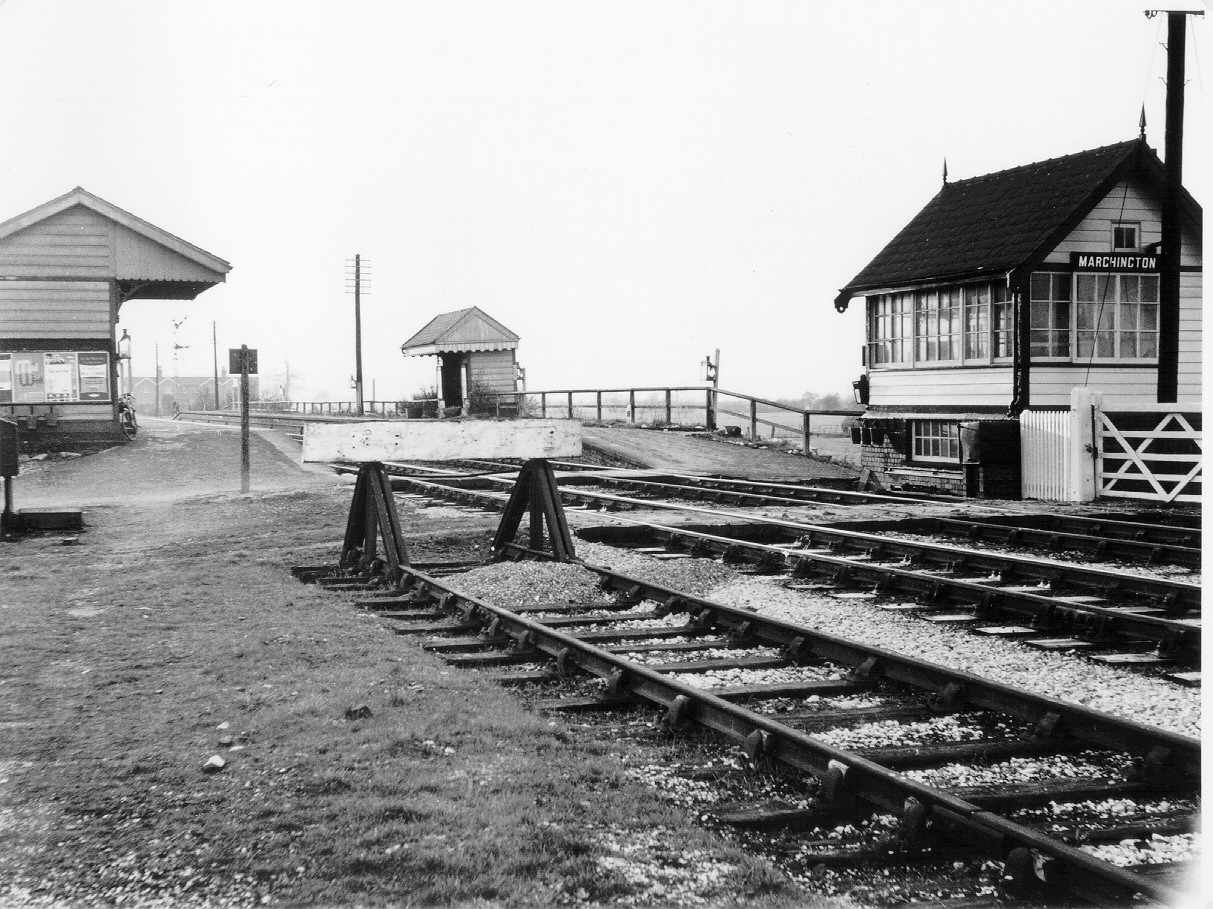
Marchington, NSR. 14th April 1882
Marchington was a wayside station in rural East Staffordshire three miles east of Uttoxeter. The station is described as having ordinary Home and Distant signals interlocked with the points and controlled from a raised platform close to the station building.
At 9.10am, Octavious Greaves, the Station Master, was in charge of the signalling, the points and block instruments.
He stopped a Down goods train to shunt it back onto the Up line to clear the Down line for following NSR and GNR passenger trains. Evidently this was to the annoyance of the driver of the goods train who believed he would have been able to clear the section if left unhindered. He berated Greaves on this point only to incur the wrath of Mrs. Greaves who told him to leave her husband alone!
Anyway, during the shunt, a van became derailed on the crossover. The derailed van was pulled away from the Up line and Single line working instituted on the Up line while a breakdown gang came from Uttoxeter.
The 11am passenger train from Derby was stopped at Sudbury and the driver informed that his train was to crossed to the Up line and run at caution through Marchington. However, as the passenger train approached the crossover at Marchington the points were suddenly reversed and the passenger train ran through the crossover into the derailed van.
Six passengers were injured as was the passenger guard. The Inspecting Officer put the unexplained movement of the crossover down to damage from the previous derailment.
Peckwash Mill, MR 12th March 1870
The "Peckwash Mill Disaster" of Saturday, 1st December 1900 is perhaps the worst railway accident Derby has been witness to. With the loss of two lives, railwaymen rather than public - as if that matters - it is certainly the most tragic. A lot has been written about it, thanks mainly to the Penny Sheet that signalman Passey of Little Eaton composed and distributed to raise funds for the families. This, and the full story of the Midland Railway piecemeal widening of the line between Milford Tunnel and Chaddesden is described on the Peckwash Mill Disaster page
Marston Crossing, NSR 12th March 1870
The first account is almost entirely a direct quote from the Derby Mercury newspaper dated 28th March 1870. The main reason for quoting it verbatim is that the language of the report is fascinating – a level of lurid detail even our modern jaded media wouldn’t dare follow. The article isn’t entirely accurate, however. The name of the unfortunate lady who met her demise was actually Mary Haviland, not Avelin – the latter being established by reference to her death certificate (the finding of which by a long lost relative of hers during a genealogical search tipped me off to the sad circumstances if her death).
Shocking Railway Accident
On Monday afternoon [14th March 1870] an Inquest was held at the house adjoining the railway crossing between Marston-upon-Dove and Rolleston, before Mr Joseph Sale, coroner, on the body of Mary Avelin, aged 42. The evidence went to show that the deceased had attended to the gates of this crossing for about four years, her husband being employed as a night watchman on the North Stafford line at Egginton. On Saturday morning she was drying some clothes on the bridge next the down line, and she crossed over the rails to attend to them at about twenty minutes past eleven o'clock, at which time the passenger train from Burton to Tutbury and the Macclesfield luggage train were due, and closely approaching the crossing. On her return, it is supposed, she was either discomfitted by the boisterous wind, or her attention attracted toward the passenger train, for she was knocked down in the four foot by the luggage train, run over, and her body literally cut in two. The husband, who was working a few yards away in his garden, hurried up to render his unfortunate wife assistance, but he only got there in time to find her a corpse, and her mangled body lying - one part in the six-foot, and the other part in the four-foot. Verdict, "Accidental Death".
Derby Road Crossing, Willington. NSR. 21st November 1882
These days many drivers on the busy A38 dual carriageway will not even knowing they are crossing a railway line as they pass over the bridge which replaced Derby Road Crossing in April 1966. In 1882, however, it was a different matter. So too was the amount of traffic!
The crossing of the 'old turnpike' called Ryknield Street over the double lines of the North Staffordshire Railway was protected by four large gates and two wicket gates on the eastern side of the road. The crossing was described as "nearly intermediate between the block posts at Willington Crossing and Egginton Junction". Derby Road Crossing was not, at the time of this accident, a block post.
The gates were normally kept locked against the road and were padlocked at night. This doesn't seem inappropriate given the amount of traffic over the crossing as shown in a survey conducted after the accident;
| Thursday 28DEC1882 | Friday 29DEC1882 |
| 6am– 6pm | 6pm – 6am | 6am – 6pm | 6pm– 6am |
| Pedestrians | 35 | 3 | 78 | 3 |
| Carriage & Carts | 47 | 4 | 66 | 7 |
| Horseback | 7 | 1 | 9 | 0 |
The working arrangement for the crossing was that when a Down train from Willington Crossing was approaching the signalman there gave Four beats on a bell. Two beats signified an Up train from Egginton. No facilities were available for the crossing keeper to acknowledge the bell. On receiving warning of an approaching train the crossing keeper was not to open the gates until it had passed or Nine beats, the cancelling signal, had been given.
Once the crossing was secure, the crossing keeper was to give an All Clear signal to the driver - a white light at night. No fixed signals were provided.
The resident crossing keeper or his wife had to be available to open the gates 24hrs a day. On the day of the accident, the crossing keeper who had
16yrs experience but only three months at Derby Road, was ill. He hadn't informed the Station Master at Egginton Junction of that fact, though.
William Core was a brick layer who was lodging at the crossing keeper's house. He had heard two beats on the bell for a Up goods from Egginton and was asked by the crossing keeper's wife to show the white light (all clear) to the train.
Thomas Argyle was the signalman at Willington Crossing who came on duty at 6pm. He said that he gave the 4 beats signal to Derby Road Crossing for the 6.40pm
Derby to Crewe passenger train driven by William Cross.
Core didn't hear the four beats, however, and was therefore unaware of the approaching Down train. Once the Up train had passed at around 7pm, he opened the gates at the request of two lads on a dray.
The driver of the Down train saw the white light turn to red and realised the gates were being opened in front of him. He whistled and braked but ran through the gates killing the two lads and the horse and injuring Core.
As a result of the Coroner's recommendation, a second crossing keeper was employed at Derby Crossing. The Inspector recommended that the crossing be done away with altogether and a bridge be provided. He suggested to the NSR that the saving of two crossing keepers' wages would go a long way toward paying for it. It seems that instead, the following year a new signal box (though not a block post) was brought into use with interlocked gates to control the crossing.
London Road Junction, Derby 0100hrs 30MAR1923
Whilst London Road Junction signal box contained a traditional mechanical lever frame, the points and signals at Way & Works Sidings signal box were all electrically operated from an interlocking frame with miniature levers. The signals operated from this box were automatically replaced to danger by the passage of a train. All the signals were still Midland Railway lower quadrant semaphores.
Shortly before 1am on Friday, 30th March 1932, Leonard Lewis was the night duty signalman on duty in Way & Works. He was offered a St. Pancras to Manchester parcels from Spondon Junction which he accepted. However, when he asked on to London Road Junction the road was refused as a Chaddesden to Birmingham freight was crossing to the western goods lines. Even so, Lewis lowered his Outer Home when he got “Train Entering Section” from Spondon Junction.
Soon after, Lewis heard a sound in his Down block instrument which indicated to him that a train was passing over the treadle ahead of the Down Inner Home. He realised it was the parcels passing this signal at danger. He shone a danger signal as the train passed his box and sent “Train Running Away on Right Road” to London Road Junction.
Signalmen Hood and Walker were on duty in London Road box but were powerless do anything but watch the two trains collide at an oblique angle at the crossover. The injuries were not serious; Arthur Halford of Leicester, the fireman of the parcels train, had to be treated for bruises on the sholder, elbow, and knee. This was sufficient to bring in the Board of Trade.
The driver of the parcels claimed the Way & Works’ Down Distant was ‘off’. As the Outer Home was indeed off it was only while looking for London Road’s signals that he saw Way & Works’ Inner Home at danger.
The Inspecting Officer, Col. Hall found that it was unlikely that the Distant was indeed off. Because of the proximity of Way & Works Down Starting signal to London Road Junction Down Home signal, the Down Distant signal lever in Way & Works was locked by the lever of the Down Distant in London Road Junction so that it could not be pulled unless the London Road Junction Down Distant was also pulled. When both of these levers had been pulled the signal lowered. The replacement of either lever concerned back in the frame restored the Way & Works Down Distant to its normal position. As there was no way London Road could have pulled off their Down Distant, Way & Works’ Down Distant must also have been locked.
It was reported that there was only one known instance of Way & Works Down Distant showing false Clear and that was a few months after these arrangements were brought into use in 1908 and was due to frost.
The Inspecting Officer, however, was understandably critical of the practice of pulling off the Outer Home as soon as “Train Entering Section” was given. There was a written instruction to signalmen not to lower it until the line was clear to the Starting signal. Lewis justified the practice by saying he was afraid of forgetting a train standing at the signal as it was out of sight. The Inspector pointed out that there was a track circuit for the 94yd in rear of the signal. Even though that track circuit wasn't in any way interlocked with the signalling it should serve as reminder to the signalman of any train standing there.
If you are interested in the grim but fascinating subject of railway accidents...
... then the Railway Archive web site is for you. An ever-growing collection of accident reports and information. Highly recommended.
Back to the main page
Dave Harris, Willington, Derby, UK.
Email: dave@derby-signalling.org.uk
Page last updated: 18MAY2014