
Focus on
By David Harris
It is unlikely that Stenson Junction was ever a quiet signal box. Although its erstwhile neighbour at Willington Junction was the first signal box in the area, Stenson Junction was to become renowned as one of the busiest signal boxes in the district.
The area's railway history begins with the building of the Birmingham & Derby Junction Railway line from Derby to Hampton in Arden, which had its opening ceremony on 5th August 1839. As is well known, amalgamations of the three companies whose routes radiated out of Derby resulted in the formation of the Midland Railway on 10th May 1844.
Willington Junction was formed by the building of the North Staffordshire Railway from Stoke on Trent which opened on 13th July 1849. The new line formed a junction 5 miles 16 chains from Derby London Road Junction (where the Midland's Mile Post 0 is located) and 29 miles 60 chains from the Knotty's Stoke Junction. Whilst the later company continued to refer to the junction as Willington Junction, the Midland followed its common - but potentially confusing - practice of naming the junction after the company it served. Therefore the Birmingham line had North Stafford Junctions at both Willington and Burton, a mere 4 miles 63 chains apart.
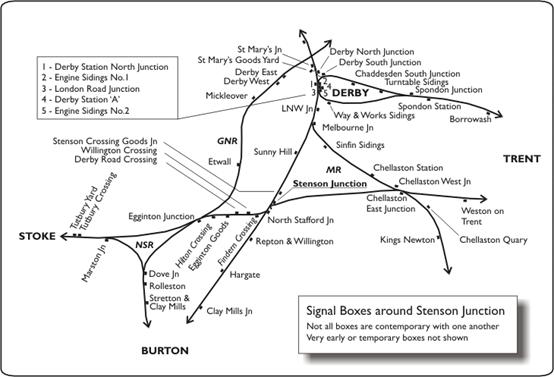
The infrastructure in the area at this time included Repton & Willington Station, 1mile 5 chains in the Birmingham direction, and the bridge over the Trent & Mersey Canal, a similar distance toward Derby. (very soon renamed North Stafford Junction, at least by the Midland)
Being literally in the middle of nowhere, there will inevitably have been some form of shelter for the pointsman or policeman at the junction from the outset. The date of the first structure which we would recognise as a signalbox is likely to have coincided with the introduction of the block telegraph in 1873. The first documentary confirmation of the existence of a signal box is in the Midland Railway's working timetable of August 1877, the first in which the company included a full list of signal boxes. The introduction of the Block Telegraph also brought about the need for a "break section" box at Sunny Hill, about the 3¼ mile post.
As was the norm when another company's line formed a junction, North Stafford Junction was built and operated by the Midland Railway with the cost charged to the North Staffordshire Railway.
Stenson Junction, at 4 miles 50 chains, came into being preparatory to the opening of the Midland Railway's Stenson & Weston line. This 4 mile 22 chain long double track line to Chellaston West Junction on the Derby & Melbourne branch opened on 3rd November 1873. With the Sawley & Weston line, which joined theMelbourne line from the opposite direction, a through route to Nottingham was formed. More significantly, as the line was always intended as a route for goods traffic, the yards at Toton could be reached avoiding the bottleneck which wasDerby.
At this time all railway companies were required to produce an annual return to the Board of Trade listing the lines that they had equipped with the Block Telegraph. The Stenson and Weston line does not appear in the return dated 31st December 1873, but 12 months later it is listed as; "Worked with the Electric Telegraph but not on the Absolute Block System". The same entry appears up to and including 31st December 1881, but in early 1882 the line was made Absolute Block.
This is all something of a paradox. The North Staffordshire Railway saw that the opening of the route to Nottingham afforded that company the opportunity to provide a passenger service to Nottingham avoiding Derby. The Midland would be quite content to allow this over their metals as it would not be taking the lucrative Derby to Nottingham traffic away from them. However, the North Staffs passenger service ceased on 30th April 1878. Although there was very likely regular excursion traffic over the line, the only reason for applying Absolute Block seems to have ceased four years previously.
This is significant as there has never been any intermediate signal box between Stenson Junction and Chellaston West Junction. With a section of over four miles and a procession of goods trains, this must have made the signalman's job at Stenson Junction something of a challenge. At the very least it has to be assumed (although I have yet to find documentary confirmation) that the Warning Acceptance applied.
These early years were undoubtedly the quietest at Stenson Junction - indeed, for the first few years the box, and therefore the Stenson and Weston line, was listed as being "Closed on Sundays and Sunday Nights".
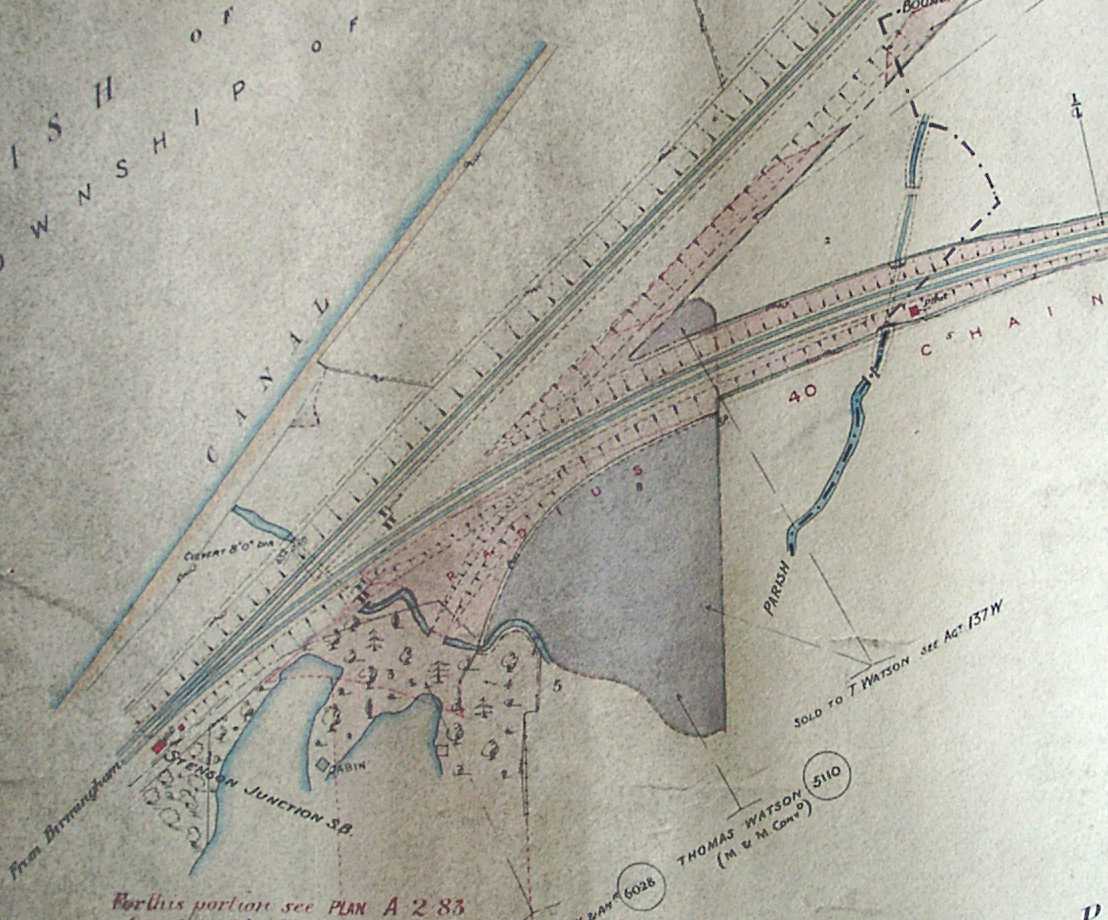
Midland Railway Two Chain to One Inch land plan showing the western end of the Chellaston line at Stenson Junction. From the Midland Railway Trust Archive RPYMR1988-183-121.
Being situated close to the canal bridge, and surrounded by land rich with alluvial gravel, the simple junction layout at Stenson Junction was added to on two occasions. Between 16th January 1893 and 7th January 1895 there was a "temporary earth siding" connected to the Down Main Line. The Weekly Notice of the time records that; "a ground disc signal to regulate the running of trains and engines from the temporary earth siding on to the down main line from Derby will be brought into use". A similar "earth siding" appears on maps of the locale around the turn of the Century, this time running into a small gravel pit to the south-east of the junction.
The traffic flows in the area, especially on the main line, in the latter years of the 19th Century were such that demand was outstripping supply. The solution was to provide goods lines wherever the topography permitted. South of Derby the narrow cutting in which Peartree & Normanton station was to be sited was one such physical limitation, and the next was the Trent &Mersey Canal Bridge at Stenson. Whilst neither would seem to be an insurmountable obstacle, the Midland Railway's Engineer clearly felt that they were sufficient to form the limit to the widening scheme. This meant that the southern end of the goods lines would effectively be in-the-middle-of-nowhere in railway terms.
Stenson level crossing, at 4 miles 16 chains, was the nearest railway installation and was tended to by a residential crossing keeper from a house on the up side of the line to the south of the crossing. This country lane formed a route between the hamlet of Stenson and the nearest village at Findern. The goods lines were therefore to be controlled at their southern end by a new 20 lever signal box sited diagonally opposite which was thus able to also control the level crossing.
The Weekly Notices record; "At 8.0am on Sunday next, October 26th [1890], a new intermediate Block Telegraph Post between Sunny Hill and Stenson Junction, at the Stenson Level Crossing, will be opened, and named Stenson Crossing. The signals will be:- An arm distant signal in the post of the Stenson Junction up home signal applicable to trains and engines going toward Derby, a home signal on a bracket on the up side of the line, and a starting signal on the up side of the line, to regulate the running of trains and engines on the up main line; A distant signal on a bracket, and a home signal on a bracket ,on the down side of the line, to regulate the running of trains and engines on the down main line; An arm signal on a bracket, alongside the home signal for the down main line, to regulate the running of trains and engines from the down line siding on to the down main line. This Signal Box will be closed on Sundays and Sunday nights"
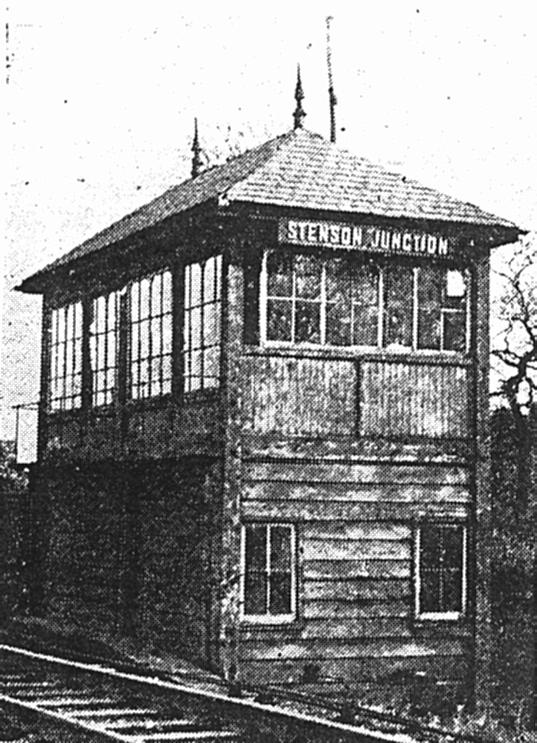
A poor quality image, but the only one to come to light of the 1892 Stenson Junction box. Photo: D.J.Harris collection.
The box was opened preparatory to the building of the goods lines. A further Notice entry dated Monday, December 15th 1890 stated that "the earth siding, when not being used by the Engineer's Department, is available for use as a down lie-bye siding". The goods lines were brought into use at 6.0am on Sunday 8th November 1891. The new metals were built on the down side so what had been the Down Main Line became the Up Passenger Line and the former Up Main became the Up Goods.
These developments would have had little effect of the work of the Stenson Junction signalman and so the job there would have remained much as it had before. The following summer, however, saw extensive activity in the area by the Midland's Signal Engineer. Replacements for the original signal boxes were brought in to use on 26th June 1892 at both Stenson Junction and North Stafford Junction and a completely new set of signals were erected at both boxes, being taken into use on the same date.
One further change in the area was to occur during the tenure of the Midland Railway, on Sunday, 8th September 1907, when "a new outer home signal for the down main line from Chellaston West Junction, about 440 yards outside the present home signal, will be brought into use, and the distant signal for the down main line from Chellaston West Junction will be placed about 440 yards further from the Signal Box".
This provides a further illustration to the problems that must have been encountered with working the line to Chellaston by Absolute Block. The distance of 440 yards is, as readers will realise, a very significant distance in signalling terms. It is reasonable to assume that prior to this change the junction was within a quarter of a mile of the home signal from Chellaston. This would mean that the signalman at Stenson would be forced to accept most trains from Chellaston West Junction only under a "Warning" - i.e. the train had to be stopped at Chellaston and allowed to proceed under a green flag, indicating to the driver that the line was clear to the next home signal only. Otherwise the Stenson Junction signalman couldn't accept a train from Stenson Crossing on the main line - until the train from Chellaston had cleared the four mile long section..... an age in operating terms.
The transition from the Midland Railway to the London Midland & Scottish Railway passed without any immediate upheaval at Stenson, although the new company's desire to make savings - especially in signalmen's wage bills - and advances in signalling technology bit hard in 1932. The use of electricity in railway signalling was, by then, nothing new. Its application was becoming more widespread and sophisticated. Basic power signalling principles resulted in points and signals being operated from far further away and the use of track circuits allowed a signalman to know that his section was clear over a distance much further than he could see. Where a signal box existed simply to break-up an otherwise long block section - such as Sunny Hill - there was definitely scope for a saving. In addition, as the signalmen at Stenson Crossing and North Stafford Junction were to discover, the technology even allowed junction signal boxes to be dispensed with.
Sunny Hill Goods Junction (actually a newer box a mile closer to Derby than the original Sunny Hill box) was to be replaced by a stage operated, when required, by guards on 15th November 1931. The following year, on 26th June, both of Stenson Junction's main line neighbours were abolished. Stenson Junction then assumed responsibility for the junction of the North Stafford line and the goods lines toward Derby, as well as the level crossing. Being little more than a cart-track, an electrically released ground frame was provided at Stenson Crossing, and it is reasonable to presume that it returned to the care of a residential crossing keeper, a less-than-onerous task.
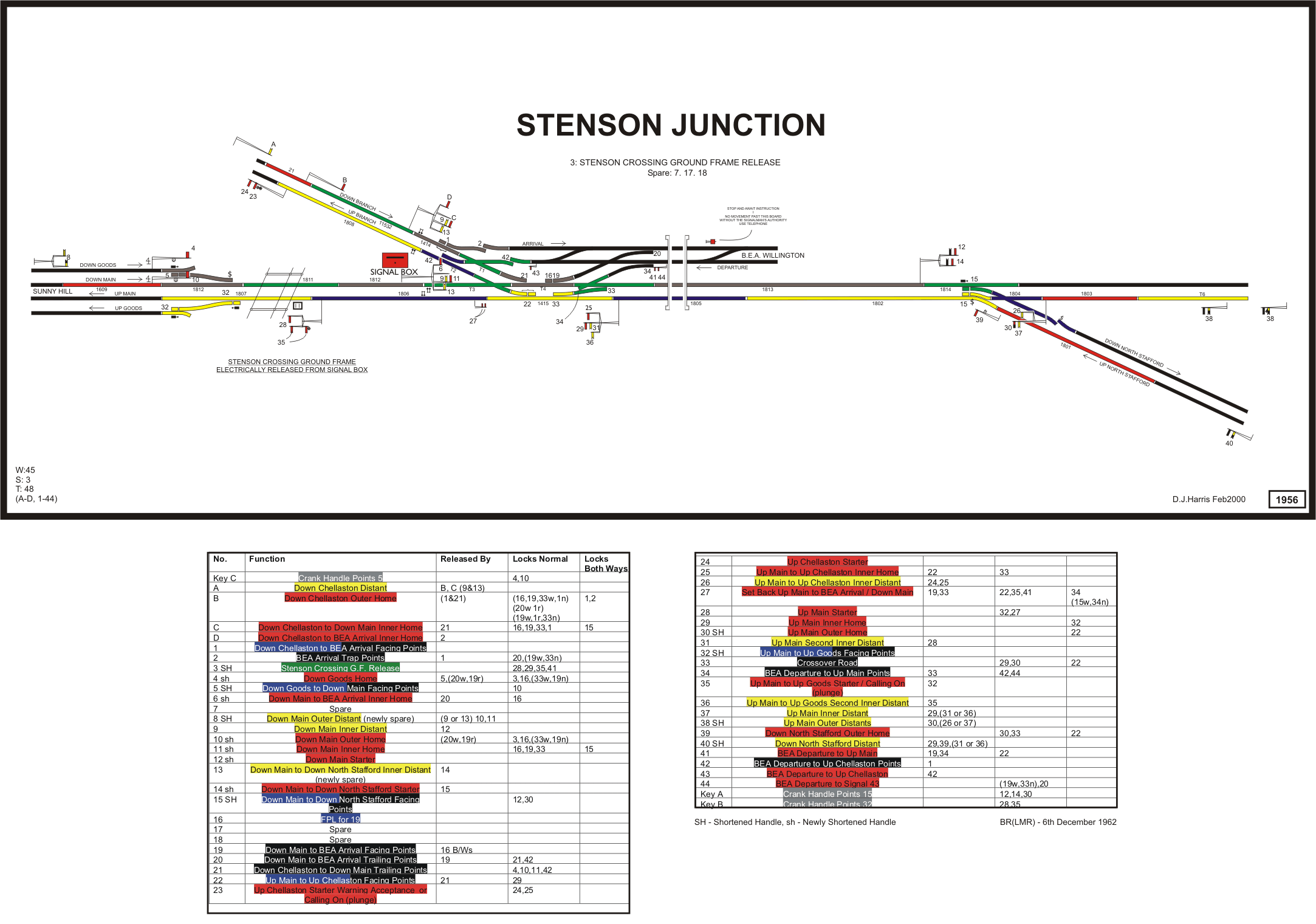
Click for a larger version (192kb)
Suddenly the job of the men at Stenson Junction had become exceptionally busy. Two geographic junctions and the start/end of the goods lines meant that from then on Stenson Junction was to be pivotal to the efficient regulation of trains south of Derby.
Unfortunately, I have not had sight of the Notice relating to the events of 26th June 1932 (I would dearly like to if anyone has knowledge of the whereabouts of such a document?). Certain assumptions can, however, be made on the basis of the signalling that survived until the post-War period. One such assumption is that the frame provided in 1892 would require replacement.
The signalling at both North Stafford Junction and Stenson Goods Junction was retained and they were effectively worked as Intermediate Block Sections - at least in as much as the signalman at Stenson Junction could accept a following train from the box in rear long before the first train had entered the section in advance. Telephones were provided at the signals so the Guard could confirm that the train had arrived complete with Tail Lamp, allowing the signalman to accept a following train before the first one had even passed his box.
To facilitate this line capacity, the box had an inordinate number of distant signals; three each on the main lines plus a 'splitting distant' each for the three junctions as well as one each on the Chellaston and North Stafford lines - a total of eleven separate worked distant arms plus a fixed distant on the Down Goods Line.
It is perhaps a fatuous comment, but the upheaval of 1932 would have had a tremendous effect on the men involved. The National Union of Railwaymen Sectional Council Promotion Scheme list of men for 1930 tells us who these individuals were:
| Stenson Crossing: (Class 4) | ||
| H.J.Wathen | 10-6-1901 | 7-11-1921 |
| J.T.Coxon | 25-6-1907 | 24-9-1923 |
| H.W.Kent | 30-10-1914 | 1-1-1925 |
| Stenson Junction: (Class 3) | ||
| C.R.Mackrill | 27-10-1899 | 20-8-1923 |
| H.Dainty | 27-3-1891 | 20-8-1923 |
| W.L.Ludlow | 7-9-1909 | 5-1-1927 |
| North Stafford Junction: (Class 3) | ||
| H.W.Alford | 12-9-1885 | 22-8-1923 |
| H.Thomas | 7-4-1919 | 2-8-1926 |
| G.S.Jones | 10-11-1919 | 7-8-1926 |
The dates refer to their becoming a signalman then to the date of the promotion into their current class.
The difficulties associated with staff being displaced were helped by the fact that William Alford had already retired after 45 years of service to the railway in March 1929.
Outside the box, there would be a great deal of change - not least the gathering storm clouds of War. Meanwhile, the work in the well-filled confines of Stenson Junction box carried on in much the same way for the next two decades. Relief for the long-running operational headache that was the four mile section to Chellaston Junction did come soon after the War.
Although it had long ago lost a regular timetabled passenger service, the Chellaston line provided a very useful diversion route and was, therefore, maintained as a passenger line for all operational purposes. A file in the Public Record Office (MT114/93) details applications made by the newly formed BR (London Midland Region) to the Railway Inspectorate of the Ministry of Transport to implement Permissive Block sections on other than Goods Lines.
The solution was to put in place a Permissive system with a set of rules which allowed it to be readily converted to an Absolute section when it was required for a passenger train. MT114/93 contains a very detailed plan of the works required to implement this. In Stenson Junction the job involved the removal of the "Ex-M.R. Drop Handle Interlocking Block" instruments to be substituted with “Ex-LNW 9 position Tell Tale Permissive Block instruments to be fitted with "Absolute" & "Permissive" Reminder Flaps”. The section signals were fitted with "Warning Acceptance" and "Calling-On" subsidiary arms both at Stenson and Chellaston Junctions.
In addition to the detail relating to the Permissive working, the diagram enclosed in MT114/93 assists us by revealing the box at that time to be furnished with a 40 lever 4½" tappet frame, six of which were spares (four after these alterations).
The post-war creation of the British Energy Authority led to a move away from town power stations to large generating stations close to the raw materials of coal & water and away from centres of population. This seemingly unconnected event was to lead to the next big change at Stenson. The Trent Valley fitted the needs of the B.E.A. perfectly and by the beginning of the 1950's plans were well in hand for the building of a power station at Willington.
Being between the coal fields of South Derbyshire and Nottinghamshire, it was always the case that the feeding of Willington - as well as the other power stations being built in the Trent Valley - would have a great impact on the railway. Willington power station was to be located on the down side of the Derby - Birmingham Line opposite North Stafford Junction. It was inevitable, therefore, that Stenson Junction was to play a part in handling the power station traffic. Quite apart from the 1892 signal box being already at capacity having taken on the job of three boxes, it was also in the way. Located on the down side, south of the junction with the Chellaston line, the old box was on the site of what was to become a facing double junction serving both the main line and the branch.
A new signal box was duly built and opened on 28th March 1954, sited 146 yards closer to Derby in the 'Y' of the existing junction. The new signal box was built to the contemporary 'standard' design, since categorised as the LMR Type 14. The new box had an LMR 4½" centres standard frame. In later years there were 48 levers, although as the left-hand four were A to D, it is probable they were a later extension.
The power station at Willington had only been part of this section of the story. The railways of 1950 were, arguably, at a zenith in terms of volumes carried - levels not seen since the Great War. The decision of the Midland Railway to end the goods lines at Stenson Crossing was now becoming a problem. It is probably best left to this contemporary (18th June 1952) memorandum to explain the problems and the suggested solution. The information it contains relating to the traffic pattern at Stenson gives us an invaluable insight into the day-to-day problems facing the signalmen in the Junction box:
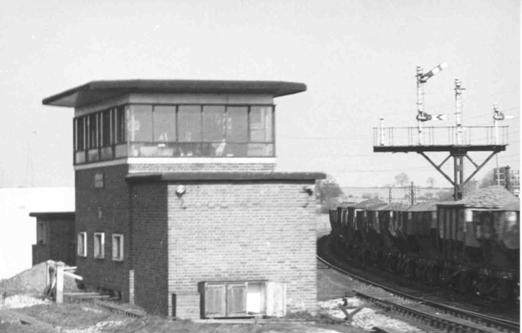
Stenson Junction from a passing Up train on 5th April 1969. A coal train is coming off the Down Chellaston onto the Down Main. The home signal which is "off" was worked by lever "C". The distant arm below was also worked from Stenson Junction (9) and related to the North Stafford Junction. The former splitting distant for the North Staffordshire route (13) had been on the short doll closest the box. The vacant doll above the signal post was provided for the goods line which was never built and never carried a signal arm. The other surviving signal routes into Willington Power Station. Photo: M.A.King.
(Source: Public Record Office AN13/338)
THE RAILWAY EXECUTIVE
MEMORANDUM TO THE BRITISH TRANSPORT COMMISSION
EXTENSION OF GOODS LINES
The British Electricity Authority is formulating a scheme for the establishment of a new power station near Stenson Junction, Repton and Willington, which is expected to be fully operative by 1960.
The new power station will be served by private sidings., necessitating a remodelling of the layout at Stenson Junction, the planning of 'which has now reached an advanced stage, and it is considered essential the question of line capacity should be developed simultaneously with the power station proposals in order to ensure, not only that the traffic will be catered for in a satisfactory manner, but also that the power station sidings may be designed to make suitable provision for additional running facilities.
It is estimated that when the new power station is fully operative, the fuel intake will involve an additional 10 trains per day, and when this situation arises, it is estimated that an additional 8 trains per day over this section of the line will be required for the additional traffic for the new and extended power stations and gas undertakings at Drakelow (Burton), Washwood Heath, Sharpness and Bristol.
There is a double line track of only 41/2 miles between Clay Mills Junction and a point about half a mile on the Derby side of Stenson Junction, with intermediate diverging junctions on the west side to North Stafford and on the east side to Trent. Even under present conditions, line capacity presents a very serious problem, particularly in the down direction, and it is not unusual during the winter for 3/4 trains to be held on the down goods line at Stenson Junction and a similar number on the Castle Donington line waiting a forward path.
A record taken for the 24 hours ending 3 a.m. on 20th February, 1952, shows that 122 trains were dealt with at Stenson Junction in the down direction, and 112 trains in the up direction. Of these, owing to line occupation, it was necessary to refuse 42 trains when first offered. Over the greater part of the day there would have been no paths for additional trains; any such trains, therefore, would have been subjected to considerable delay, and this in turn would have resulted in reactionary delay to following trains.
In order to cater for the additional traffic to and from Willington power station, it is considered that the up goods line will require to be extended from Stenson Crossing to Stenson Junction, and the down goods line from Stenson Crossing to North Stafford Junction, but although this will facilitate the working of traffic to and from the new power station, it does not meet the full needs, as facilities are required to enable a down train for the North Stafford direction to by-pass a train for the Burton direction.
It is proposed, therefore, that the down goods line should be further extended to Repton and Willington station, which will enable North Stafford direction trains to be segregated from Burton direction trains, and also enable the latter to be brought nearer Clay Mills, and so take advantage of shorter margins between Repton and Clay Mills.
Plan 604-52 shows by red colour the proposed extension of the goods lines and a "shot" estimate of the cost of the work, exclusive of signalling, is L150,000 which includes a figure of L1,600 for land.
Parliamentary Powers will be required in connection with the works indicated and particulars of these will be included in the submission to be made shortly in regard to the Bill which the Commission will be promoting during the Session 1952/1953.
In the meantime, it is recommended that the New Works aspect of the proposal be approved in principle, on the understanding that a further submission will be made in due course, giving a firm estimate of the outlay and financial details and accompanied by final plans.
Signed...
[over-stamped "Recommended for Approval - Chief Secretary"]
18th June, 1952.
The plans for the new signal box undoubtedly assumed the down goods line was to be duly extended as the box was set back sufficiently from the existing down line. Similarly, the double line into the power station also left enough room for the new down goods to lie between it and the main line. Even the new signals on the down main line and the down Chellaston carrying the "splitting" home signals for the power station connection had an additional "doll" for the directing signal onto the down goods.
Yet it was never built! As we've seen from the above memo, the case for the goods line was compelling and it was approved - everything was in place for it except the canal bridge. Was it the same minor civil-engineering requirement which had dissuaded the Midland Railway's Engineer 60 years previously that was also responsible for an about-turn by British Railways? Equally, the down-turn in traffic that characterised the late 1950's may also have lessened the potential benefits of the goods line. Even without the proposed goods lines, by the time Willington power station opened the signalman at Stenson Junction had 12 different directions from which trains could arrive or depart!
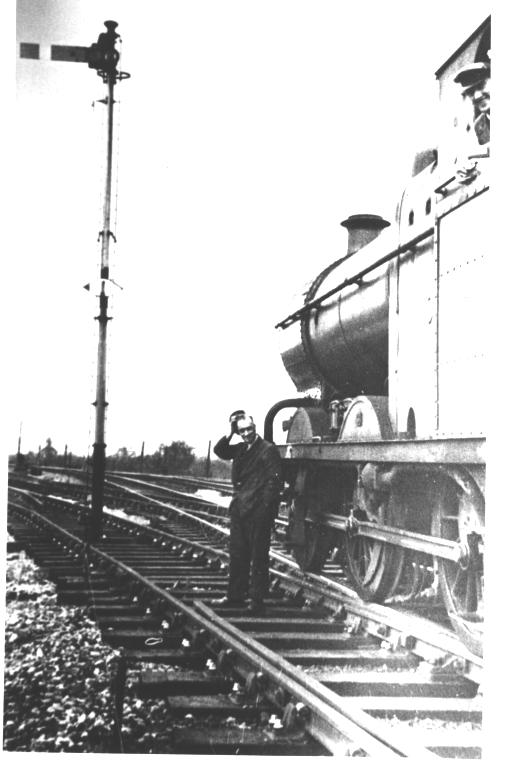
Toward the end of 1956 construction began on the new connections for the power station. By the time the point work was laid-in, it was done so around the existing signalling. This led to the bizarre sight of the old home signal on the Chellaston line standing in the four-foot of the power station line. The local wags couldn't resist it and a photograph was posed with a loco standing at the signal and a bemused looking driver standing at the foot of the signal.Photo: Courtesy Midland Railway Trust Archive RPYMR/1998/23/51
Here is the story of a new signal at Stenson Junction.
Busy as he was, the signalman at Stenson Junction had every modern convenience. Not only did it have inside "facilities" but it had a central heating system, which provided its own benefits, quite apart from heat. Let Ted Timms, a relief signalman who worked the box, explain; "Oh yes, you used to get half an hour's overtime for stoking the fire! At the end of the shift you had to go and make sure it was stoked up. It was a solid fuel boiler under the box with radiators which was very unusual and you used to get the half an hour's overtime for banking the boiler!". Ted has another recollection Stenson Junction which is equally enlightening concerning the job; "They always used to have cats there. I was the only one who used to bother about getting food for the cats. I said to the station boss at Willington one day, as a joke, whether we could have an allowance to feed them and he said 'I don't see why not'. The cats had kittens there but quite a few got knocked down before they had learned to cross the line. They used to come in and sit on the block shelf but the bell would make them jump but before long they'd just lie there on top of the block instruments and not bother at all."
Another man who worked at Stenson Junction was Roy Pearson, although he wasn't a signalman. At 2200hrs on Sunday 22nd May 1966, the Control Office at Derby closed to amalgamate with the Nottingham office as a Divisional Control. At the age of 24 Roy moved from his desk job as a Train Controller at Nottingham to become a Controller out-stationed at Stenson Junction as part of a policy of having controllers "on the ground". Provision was made in the box for the Controller with a desk at the south end of the box looking out over the power station. Responsibility for Train Regulation fell to the Controllers at Stenson Jn, Clay Cross Jn and Trent North Jn boxes. The Stenson Controller's area was bounded by Tutbury Sidings, Wetmore Sidings, Chellaston Jn and L.N.W. Jn (Derby) inclusive. As Roy says; "The signalman's job was really just to pull-off, we were there to say what should run when and in what order. In reality the signalmen knew as well as if not better and just got on with it. We all worked well together as a team ".
There could often be six or seven trains waiting on the Chellaston line. Friday evenings were always particularly busy with Northeast - Southwest holiday trains, which were always packed. Roy recalled a Newcastle - Torquay express which failed at Stenson Junction one day. The engine of a coal train waiting on the Chellaston branch was used and the express got away with only 17 minutes delay.Roy continued; "Trains used to take an age to come off the North Stafford on the Up, you'd pull off and wait and wait. You used to get to know the drivers and how they worked and if you could rely on them to make good time. If a particular driver worked the same turn all week and was reliable he'd get the outer distant off the Chellaston line and be allowed to make good progress. That was about a mile away and a very heavy pull so it didn't come off very often".
A former Train Recorder in the area in the late 1960's was Christopher Thacker. He didn't work Stenson Junction but recalls the effect that regulation at Stenson could have on the surrounding railway network. He said; "The Stenson - Sheet Stores line was always blocked up with freight awaiting a path at Sheet Stores or to be accepted at Toton Yard. There was an afternoon Manchester - London passenger which came off the North Stafford to go via Chellaston. As the line was worked by Permissive Block except for passenger trains, freights had to be held on the Up Goods at Clay Mills to allow the Permissive Block section to be cleared and the line emptied to Sheet Stores Jn. It would take an age to clear the resulting back log on the Up Goods at Clay Mills". His story is a good illustration of the foresight of the early B.R. Managers of 1950 who decided to retain the Chellaston line's passenger capability. Incidentally, the train Mr. Thacker refers to was diverted because of West Coast electrification and was often hauled by an English Electric Type 4 - a novelty in the area at the time.
There was a Controller on each shift at Stenson Junction and Roy Pearson's regular mate was a chap named Frank Harris. Other men at the box at the time included George Kenny, who went as shunt foreman at the Power Station when the box closed, and David Sutcliffe who took Roy Pearson's job. For his part, by 1968. Roy had seen that "the writing was on the wall" and left the railway. He knew he would probably get a job somewhere on BR "but it could be sweeping the platform at Aberdeen!". He was just setting up home with his wife and family at Leicester and couldn't afford such upheaval.
The writing was, indeed, "on the wall". Some minor improvements had been commissioned on 6th December 1962. Colour lights were installed along the Down Main. The Down Main distant became a two aspect automatic and its twin on the Down Goods a single fixed yellow. The remainder of the Down signals became three aspect colour lights with the splitting homes replaced with feathers. Comment has been made that this was a retrograde step as the benefit of the splitting distant was lost, though in reality the change was the result of a 'near miss' of sufficient severity to bring in the Government's Inspectors. Garth Ponsonby provides the details; "The signalman obtained line clear and pulled off for the North Stafford route, although the train was a DMU for the Birmingham line. The driver took the clear signals for some reason, and went through the junction at nearly line speed although the limit onto the North Staffordshire line was 20 mph. Whilst the train stayed on the track, it was considered sufficiently serious for an inquiry. As a result of the incident, not only was the down signalling altered to colour light, with approach control locking on the junction signal (and the splitting distant abolished) but the junction itself was aligned to give a higher speed. It was of course signalling policy at about that time to abolish splitting distants as being potentially unsafe. I recollect that the up splitting distants for Ambergate South Junction (to the main and slow lines respectively) were also abolished about then."
From around 1965 plans were fairly well advanced for a power signalling scheme for theDerby area. Part of the modernisation involved the provision of Automatic Half-Barriers on three of the crossings on the North Stafford line.
Since the closure of North Stafford Junction box, Stenson's neighbour on that line had been Willington Crossing, 1mile 882 yards distant. This North Staffordshire Railway Type 2 box dating from 1902 was located on the Up side of the line ("Up" being toward Derby, even on the Stoke line) and was equipped with a 12 lever McKenzie & Holland frame, six of which were spare.
Situated between North Stafford Junction and Willington Crossing was Findern Crossing and beyond Willington was Derby Road Crossing where the extremely busy A38 crossed the line. Findern and Derby Road Crossings were both non-block posts supervised from Willington Crossing. The upgrading of the A38 to a dual carriageway resulted in Derby Road Crossing being replaced by a bridge and the crossing being formally "stopped-up" on 30th November 1967.
The planned demise of Derby Road Crossing had opened the way for the remaining, much quieter, crossings to be converted to AHBs. Findern Crossing had its barriers commissioned On 26th November 1967, whilst Willington Crossing itself was converted to barriers the following weekend, closing on 3rd December 1967, both crossings subsequently being supervised by Stenson Junction.
The block section was now 3 miles 1528 yards to Egginton Junction, the box in between, at Egginton Goods, having been an early AHB conversion on 4th July 1964. Meanwhile, back on the Derby line, Stenson Crossing was relegated to "occupation" status and later padlocked.
It wasn't until the evening of Saturday, 28th June 1969, as part of the second phase of the Derby Power Box, that Stenson Junction was abolished. A ground frame was substituted for emergency use of the crossover road on the Power Station lines, otherwise control was from Derby.
Drivers took a little while to forget old habits (and terminology), however. Ted Timms relates the account of a driver wrongly routed at Burton; “He came on the phone at Clay Mills and said, ‘Well, I whistled at Stenson, mate!’ — I don't know whether he was joking or he thought we had good hearing!”
Many thanks to those individuals named in this piece for sharing their memories with me, to all who have (and continue) to share their knowledge in the course of my hobby in researching these matters, especially to Roger Newman who has been especially generous with his time and knowledge specifically in respect of this article.
First written 30OCT2005 (slight revision 25NOV2009, 25FEB2013, (18MAY2014 - formatting))
Dave Harris, Willington, Derby, UK.
Email: dave@derby-signalling.org.uk
Page last updated: Sunday, 30 August 2015